
It’s an Xbox 360 controller, Grandpa!

Xbox 360 Controller

Editor’s note: When one of our staff spent time playing video games with his grandson, he gleaned an insight into the challenges that face us when we try to explain the gospel message to someone who is biblically illiterate.

My wife and I were visiting our grandchildren for the first time since they acquired a state-of-the-art video game console—a gift from a generous neighbour. The youngest, 7-year old Thomas*, was beside himself with excitement. He could hardly wait to show me his prowess.

I was no sooner in the house when Thomas plopped a strange-looking object into my hand. The clear plastic, kidney-shaped device immediately reminded me of the cockpit of a commercial jetliner. Buttons, toggles, switches, levers, dials and diodes of every size and colour poked out at odd angles and from all sides. I asked Thomas, “What is it?”

The look on his face betrayed utter surprise that someone as old and wise as Grandpa could be so uneducated. “It’s an Xbox 360 controller, Grandpa!”

Well of course! I guess I should have known that. But the truth was, I didn’t know. “You’ll have to show me, Thomas,” I ventured, for I knew full well this was the response he was hoping for.

Thomas led the way downstairs where he plugged the controller into another mysterious piece of equipment, turned on the TV and began pressing and poking buttons with the dexterity of my great aunt’s knitting needles.

A snazzy red race car appeared on the monitor, sound effects and all. In response to Thomas’s nimble fingers, the powerful car navigated the speedway with amazing precision and realism. Thomas’s body twisted and jerked in concert with each bend and turn of the racetrack. It was obvious my grandson was on familiar ground, in his element; I was definitely out of mine.

Later, when it was my turn to operate the controller, disbelief and frustration were evident in my grandson’s face as he watched me struggle to extract my race car from high in the grandstand.

Reflecting on the experience later, it occurred to me there are multitudes of people who are as unfamiliar with the Bible as I was with my grandson’s video game. The pages and events of Scripture are a complete mystery to them. It may seem incredulous to us that a person could be totally ignorant of the Bible but, in reality, more and more people in our society are biblically illiterate. Put a Bible in their hands, and they will feel much like I did trying to operate my grandson’s Xbox 360 controller.

The Scriptures record how a Middle-Eastern man—a very intelligent Ethiopian official—struggled to make sense of the Bible. When he was asked if he understood what he was reading, he replied, “How can I, unless someone explains it to me?” (Acts 8:31 NIV)

In our eagerness to share the good news of God’s Word, are we doing enough to help our friends and loved ones understand the gospel message? If we hand them any Christian book, or a tract with only brief explanations, wouldn’t it be akin to handing them an XBox 360 controller for the first time without any explanation?

Instead, what if we handed our friend a tool specifically designed for people with no knowledge of the Bible, a tool that will gently, respectfully and objectively explain the Bible’s core message. Wouldn’t that be a better help?

To understand how we’ve carefully written our tools in order to simply and clearly explain the Bible’s message, please visit our Tools Architecture Page.

(*Name changed as per GoodSeed policy.)

Photo credit: “Xbox 360 Controller” by Scott Ackerman is licensed under CC BY 2.0

It’s not about the light bulb!


lightbulbHow life’s interruptions are hidden opportunities to further the gospel.

Pastor Dave,* in his closing remarks on Sunday, quoted 2 Corinthians 5:20: “Therefore, we are ambassadors for Christ, God making his appeal through us.” He challenged the congregation to believe the Lord for “divine appointments” in the coming week. He explained that if we were ready and willing, God would give us opportunities to have spiritual conversations with people. “Some may already be believers and God can use you to encourage them. While others don’t yet know Christ… you may be the one to share the gospel with them–perhaps for the first time.” I’m sure each one in the congregation, like me, filed out the door with visions of “divine appointments” dancing in our heads.

How did it go? Well, to give you an idea, here’s a snapshot of a typical week for me:

Continue reading “It’s not about the light bulb!”

Why do you give the name Yahweh high profile in By This Name and What are Christmas and Easter all about?

yhwh sky

For those with limited experience confronting non-biblical worldviews, the use of Yahweh in these books seems a little unnecessary. Why even bring that name up? Will it not be confused with Jehovah Witnesses?

To start with, those who are biblically illiterate wouldn’t know that the name Jehovah and Yahweh are related. So it is no problem to them—they don’t make the connection to the Jehovah’s Witnesses. As for the Jehovah’s Witnesses themselves, they do know the connection, which makes these two books more acceptable to them rather than otherwise.

Continue reading “Why do you give the name Yahweh high profile in By This Name and What are Christmas and Easter all about?”

Theology, Mystery and an Old Riddle

puzzle and book

Theology—the way it could have been

If I am honest, I sometimes wish that the Bible had been written more like a textbook of systematic theology. I wish that the Apostle John would have included an inspired chart along with his letter to the seven churches. It would have been helpful if Ezekiel had spelled out exactly what he meant by his visions. And, like the disciples, I would have preferred if Jesus had not spoken in so many parables.

It’s a mystery and that’s okay

But God, in his great wisdom chose not to. Maybe if all we had was a theology textbook then we would all be very pious people … dead in our orthodoxy. Those things in the Bible that are not clearly laid out for us cause us to seek Him, and in doing so, to grow in His grace.

Continue reading “Theology, Mystery and an Old Riddle”

How do I use visual aids to teach the Tabernacle to children?

Tabernacle Sunday school class

The tabernacle of Moses can be a difficult subject to teach, especially to children. How do you explain the meaning of this seemingly obsolete structure, its strange furnishings, and all the complicated priestly rituals related to it?

Pam*, a children’s ministry director at a California church, found that with the help of the free Sunday school lessons and painting guide downloaded from GoodSeed, her first-to-fifth-grade Midweek Group was soon absorbed in the great visual aid God gave the Israelites that points to Christ.

Continue reading “How do I use visual aids to teach the Tabernacle to children?”

How can I know that things are right between me and God? How can I know that when I die I will live forever in a place that is secure and happy?

clouds

Before we can answer that question, we need to recognize some things about God and ourselves.

1. First of all we need to understand that the Lord God is a holy God. He exists in all His majesty, being the Creator-Owner of the Universe. He is a loving, caring God, but equally He is also a holy lawgiver. His holiness demands that His law be kept perfectly. He can have nothing to do with any lawbreaker. It is right to say that only perfect people can live with a perfect God.

“. . . without holiness no one will see the Lord.” (Hebrews 12:14)

On the other hand, we are helpless sinners. We were born into the world lawbreakers, alienated from God. We are far from perfect; we are sinners. God’s law says that all sin demands a “death” penalty.

Continue reading “How can I know that things are right between me and God? How can I know that when I die I will live forever in a place that is secure and happy?”

Divine North!

compass Spiritual stories are a hot commodity. This was evident in the leaflet thrust into my hand by an eager panhandler in downtown Edinburgh. “Storyteller Angela Knowles is on a journey into the rich and diverse world of stories in faiths and spiritualities. Would you like to share that exploration?” The pamphlet was a reminder that postmodern values are alive and well, a way of thinking that assigns equal value to stories of all faiths. We label such “stories” as worldviews. Worldviews are innumerable—Atheism, Animism, Monotheism, Pantheism, Polytheism, Empiricism, to name only a few. A religion is a worldview. No doubt the Scottish storytelling emporium would have resembled the first-century philosophers in Athens who,

“…spent their time doing nothing but talking about and listening to the latest ideas.” (Acts 17:21)

Continue reading “Divine North!”

What is the point of the Bible?

what is the point
“I’ve read and read… but what’s the point?!”

My friend Joel* was confused and his frustration boiled over as we talked. A college student with a girlfriend and a new baby at home, Joel sincerely wanted to make better decisions for his young family. In his desperation he told me that he had begun to read the Bible for the first time in his life. And read he did!

Using a read-through-the-Bible-in-a-year approach, he bounced between much of the Old Testament and most of the gospels in only a few months’ time. But his motivation was fading–fast!

Continue reading “What is the point of the Bible?”

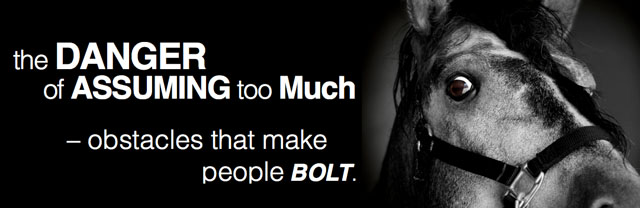
What problems come about from assuming too much when we share the message of the Bible?

Horse bolting

“I gotta get going!”

Anthony* tossed the phrase into the discussion with a shrug and a backwards step. Then he bolted out of sight around the corner without so much as a wave.

He did not return.

A familiar sense of frustration crept in as I watched Anthony disappear… I recalled my teenage years when riding horses in some very rugged terrain. Once while cantering along a mountain trail, my horse suddenly froze, then bolted off course leaving me in a dazed, bruised heap on the ground. I lifted my head just in time to catch a glimpse of the steed galloping over a distant hill, its saddle empty and the stirrups flapping. I had assumed the trail was clear of obstacles, but apparently my mount thought otherwise.

A similar scenario happened with Anthony.

Continue reading “What problems come about from assuming too much when we share the message of the Bible?”

Where in the Scriptures does it say that God told Cain and Abel to bring a blood sacrifice?

Cain and Abel at the altar
Question:

Where in the Scriptures does it say that God told Cain and Abel to bring a blood sacrifice? My Bible footnotes say that the problem was with Cain’s attitude, not the sacrifice—that a bloodless offering was quite acceptable.

Brief Answer:

We know from Hebrews 11:4 that God considered Cain’s sacrifice the wrong sacrifice. The only thing we can assume strictly from the text is that the right sacrifice would have been the same as Abel’s.

By faith Abel offered God a better sacrifice than Cain did. By faith he was commended as a righteous man, when God spoke well of his offerings. And by faith he still speaks, even though he is dead.  (Hebrews 11:4)

Notice it says “a better sacrifice,” not “a better attitude.” God spoke “well of his offering,” not “well of his attitude.” No doubt Cain’s attitude was wrong as well, but Scripture does not say so in this passage.

We know that Abel’s sacrifice had all the attributes of a burnt offering type of sacrifice, which would have been a blood sacrifice offered as a covering for sin. Bloodless sacrifices[1] are not recorded in the Bible until the time of Moses. A careful analysis of the passage yields no other solid interpretation except that God told them exactly what to do. Abel obeyed and God was pleased. Cain did his own thing and God was displeased.

Continue reading “Where in the Scriptures does it say that God told Cain and Abel to bring a blood sacrifice?”